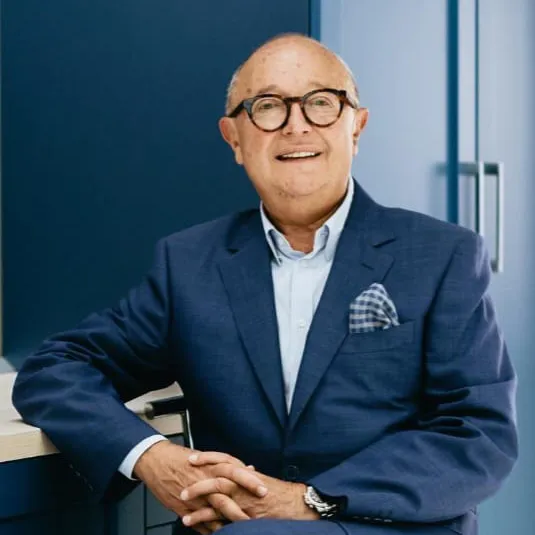
Author
Volodymyr Tsepkolenko
MD. PhD
President of the Ukrainian Society of Aesthetic Medicine
“Our role is not to define beauty.
Our role is to define what good medicine means in aesthetics.”
WHO WE ARE
What Is Aesthetic Medicine Today?
Over the past few decades, aesthetic medicine has changed almost beyond recognition.
New surgical techniques, injectable treatments, lasers and energy-based devices, as well as cellular and regenerative technologies, have transformed our field. Never before have physicians had such a wide range of possibilities to correct and restore human appearance.
Alongside these advances, an enormous industry has emerged — congresses, masterclasses, educational programmes, new products and new devices. For many years, technology itself has largely driven the development of our field.
This stage was necessary. It provided aesthetic medicine with an extraordinary therapeutic armamentarium.
But today, perhaps it is time to ask a more fundamental question:
WHO ARE WE?
If we ask professionals to define aesthetic medicine, the answer is often a list of methods: botulinum toxin, fillers, lasers, energy-based technologies, plastic surgery, regenerative treatments.
Yet no medical specialty is defined by the tools its physicians use.
Cardiology is not an electrocardiograph.
Surgery is not a scalpel.
Dermatology is not a dermatoscope.
A cardiologist may treat a patient medically. An interventional cardiologist may perform an endovascular procedure. A cardiac surgeon may perform an operation.
The methods, degree of invasiveness and required competencies are different.
The medical field remains the same.
Why should aesthetic medicine be different?
A Specialty Is Not Defined by Its Tools
We propose to consider aesthetic medicine as a field of medicine concerned with:
The diagnosis and treatment of congenital and acquired aesthetic conditions using surgical and non-surgical methods.
The order of these words matters.
First comes diagnosis.
Then comes treatment.
Only then comes the choice of method.
Not the other way around.
A laser, a needle, a surgical instrument, an energy-based device or a cellular technology is a tool in the physician’s hands. None of these tools, by itself, defines a medical specialty.
Modern aesthetic medicine encompasses a broad spectrum of interventions — from non-invasive and minimally invasive procedures to interventional, surgical, tissue-based and cellular therapies.
Medicine will continue to develop new approaches that become increasingly difficult to place within traditional professional categories.
The boundaries of our specialty should therefore not be determined by the invasiveness of the tool we use, but by what we diagnose, what we treat, and the medical outcomes for which we take responsibility.
Not Everything Related to Appearance Is Medicine
Another important distinction must be made.
Human beings have always cared about their appearance. Cosmetic care, skin maintenance and beauty treatments have their own history, professional culture and legitimate place.
But not everything related to appearance is medicine.
Cosmetic care and aesthetic medicine can complement each other extremely well, but they are not the same.
Aesthetic medicine begins where medical diagnosis, medical indications, an understanding of biological processes, risk assessment and medical responsibility for outcomes become necessary.
This is why an aesthetic physician cannot be defined simply as someone trained to perform a particular set of procedures.
What defines the physician is, above all, a way of thinking.
From the Procedure to the Patient
Years of rapid technological development have created a paradox.
The number of available procedures has continued to grow, while the procedure itself has increasingly become the starting point of the conversation with the patient.
“What can we inject?”
“Which device should we use?”
“Which procedure should we perform?”
These questions are understandable within the aesthetic services industry.
Medicine must begin with a different question:
What is happening to this person?
The physician is not treating a wrinkle, a nasolabial fold, a loss of volume, or a photograph that needs to be brought closer to a fashionable aesthetic standard.
We are treating a person — with individual anatomy, tissue characteristics, congenital, age-related and acquired changes, previous interventions, associated medical conditions, expectations and, above all, individuality.
Only after understanding these factors can the physician answer the next question:
Is an intervention necessary at all – and if so, which one?
Sometimes the appropriate answer will be cosmetic care.
Sometimes it will be lifestyle modification or treatment of a medical condition outside the boundaries of our specialty.
Sometimes it will be a non-surgical treatment.
Sometimes surgery.
Sometimes a combination of approaches.
And sometimes the most professional medical decision will be to do nothing.
The ability to perform a procedure is not, by itself, an indication to perform it.
Aesthetic Medicine Is Maturing
We are not suggesting that the achievements of previous decades should be rejected.
Quite the opposite.
Surgical, injectable, laser, energy-based and emerging biological technologies have created modern aesthetic medicine.
But the maturity of a medical specialty is not measured by the number of procedures it can offer.
It is measured by its ability to determine:
Which patient needs which treatment, when, and why.
The next stage in the development of aesthetic medicine should therefore not be simply another expansion of the catalogue of available procedures.
It should be the development of diagnosis, clinical reasoning, objective outcome assessment, evidence-based practice and long-term medical responsibility.
This is a transition from the procedure to the patient.
From correcting an isolated visible sign to understanding why it appeared.
From standardising appearance to preserving individuality.
From technological competition to the development of a true medical specialty.
The Role of UIME
The International Union of Aesthetic Medicine should not represent a particular technology, product, device or commercial direction.
UIME should represent the profession.
Our task is to create a space in which physicians from different schools and disciplines can work together to define the medical foundations of aesthetic medicine for the twenty-first century.
What do we diagnose?
What do we treat?
What knowledge should an aesthetic physician possess?
Which diagnostic methods should become part of our specialty?
Where should the boundaries of professional competence lie?
How should we objectively assess the effectiveness and safety of treatment?
How can we introduce new technologies without allowing marketing to move ahead of evidence?
And ultimately, what should the education and training of an aesthetic physician look like?
The answers to these questions will not appear in a single day.
Our task is not to build new walls between professionals, but to propose a path along which our specialty can continue to develop.
A path based on clinical reasoning, diagnosis, evidence, medical responsibility and respect for the individuality of every patient.
The Question Before Us
Perhaps the most important question for aesthetic medicine today is no longer:
“What new thing can we do?”
but:
“Who are we – and what kind of medicine do we want to become?”
Technology will continue to evolve.
New devices will appear.
New biological approaches will emerge.
New therapeutic possibilities will become available.
But the future of aesthetic medicine cannot be determined by technology alone.
It must be determined by medicine.
By our ability to diagnose.
By our ability to choose the appropriate treatment.
By our ability to distinguish an indication from a possibility.
By our responsibility for the patient before, during and after treatment.
And by our willingness to preserve the individuality of the person rather than simply reproduce an aesthetic standard.